If you’ve spent even one winter working in the Great Lakes State, you know the drill. You leave the job site on a Tuesday in 45-degree drizzle, and by Wednesday morning, you’re chipping two inches of ice off your equipment in sub-zero winds. Michigan doesn’t just have “weather”—it has a vendetta against outdoor materials.
Whether you’re spec-ing out a new commercial patio in Grand Rapids or choosing fasteners for a lakeside structure in Traverse City, the stakes are high. Get it wrong, and you’re looking at spalled concrete, rotted wood, or warped plastics before the first tulips even pop up in Holland. Honestly, I’ve seen projects that looked like a million bucks in October turn into a maintenance nightmare by April just because someone forgot how much water expands when it turns to ice.
We’re going to walk through the exact process for Material Selection for Outdoor Applications in the Michigan Climate. Think of this as your blueprint for building stuff that actually lasts. And hey, if you’re worried about the fine print on those supplier contracts while you’re sourcing these heavy-duty goods, you might want to check out our take on why boilerplate can ruin your day.
Prerequisites: What You Need to Know Before You Spec
Before we dive into the “how-to,” let’s make sure your mental toolbox is ready. You aren’t just looking for strong materials; you’re looking for resilient ones.
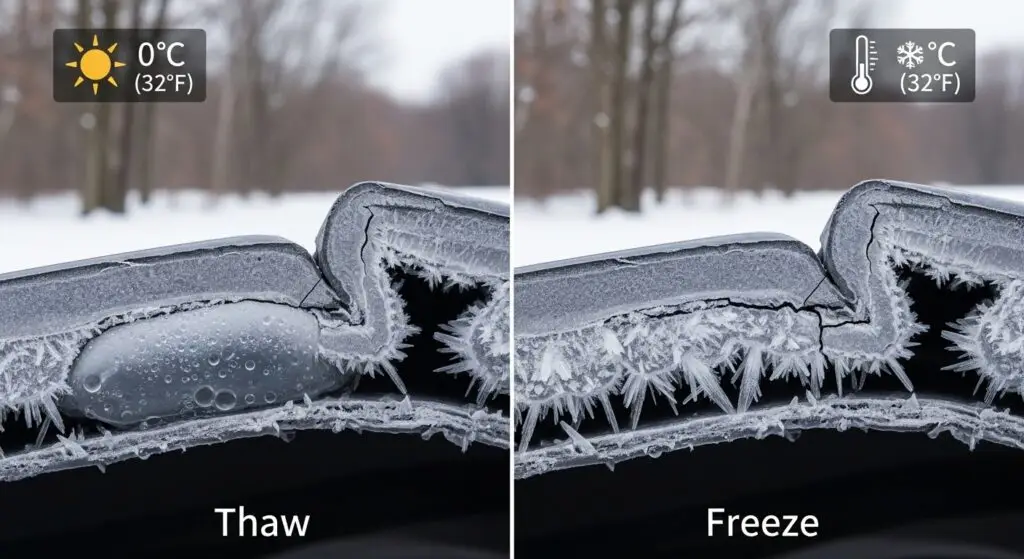
- Understand the Freeze-Thaw Cycle: Michigan can go through dozens of these cycles in a single month. Water gets in, freezes (expanding by about 9%), cracks the material, thaws, and repeats.
- The Salt Factor: If your project is near a road or a sidewalk, corrosion-resistant isn’t a suggestion—it’s a requirement.
- UV and Humidity: Don’t forget the humid Michigan summers. Lake effect moisture and intense summer sun can degrade polymers and coatings just as fast as the ice.
- Local Codes: Always keep an ear to the ground for local Michigan municipality requirements, especially regarding drainage and structural loads.
Step-by-Step: Picking Materials That Don’t Quit
Step 1: Assess Porosity and Water Absorption
The absolute first thing you need to look at is how much water the material sucks up. In Michigan, porosity is the enemy.
- The Action: For stone or masonry, stick to high-density options like granite or properly sealed pavers. If you’re using concrete, ensure it’s air-entrained. These microscopic bubbles give the freezing water a place to expand without blowing the face off your concrete.
- Tip: Check the absorption rate. Anything over 3% is asking for trouble in a Michigan winter.
- Expected Outcome: Materials that resist “spalling” (that ugly flaking you see on old sidewalks).
Step 2: Account for Thermal Expansion
Michigan sees a temperature swing of over 100 degrees throughout the year. Materials grow in the summer and shrink in the winter.
- The Action: Choose materials with a low Coefficient of Linear Thermal Expansion (CLTE) or design for movement. If you’re using engineering plastics, look for grades stabilized with glass or carbon fiber.
- Warning: Never bottom out your joints. If you don’t leave room for a material to grow in July, it will buckle or snap.
- Expected Outcome: A structure that doesn’t warp or pop its fasteners when the sun finally comes out.
Step 3: Grade Your Metals for Corrosion
Between the lake spray and the road salt, Michigan is a literal rust factory.
- The Action: Stop using standard “exterior” hardware. Use 304 or 316-grade stainless steel, or hot-dipped galvanized steel at a minimum. For high-visibility or structural areas, powder-coating over a zinc primer is the pro move.
- Expert Insight: I’ve seen marine-grade hardware fail because people didn’t account for galvanic corrosion—where two different metals touch and eat each other. Use nylon washers to keep them separate.
- Expected Outcome: No red streaks of rust ruining your clean design after year two.
Step 4: Evaluate UV and Chemical Stability
Michigan summers can be surprisingly brutal. Intense UV rays can turn a flexible plastic brittle in a single season.
- The Action: If using polymers or composites, specify UV-stabilized grades. Look for materials that have carbon black or hindered amine light stabilizers (HALS) baked in.
- Tip: If you’re building a deck or pergola, consider High-Density Polyethylene (HDPE)—it’s basically bulletproof against Michigan weather.
- Expected Outcome: Colors that stay bright and surfaces that don’t get chalky or brittle.
Visualizing the Problem: The Freeze-Thaw Cycle
This visual is essentially why most budget-friendly materials fail here. If there is a way for water to get in, Michigan’s climate will find it and use it like a wedge to pry your project apart.
Troubleshooting Common Material Failures
| Issue | Likely Cause | Solution |
| Efflorescence (White powder on brick) | Moisture wicking through the wall. | Improve drainage and use a breathable silane/siloxane sealer. |
| Heaving Pavements | Poor base preparation and frost action. | Dig deeper. Ensure at least 6-12 inches of compacted aggregate. |
| Cracked Wood Posts | Wet-dry cycles are causing checking. | Moisture wicks through the wall. |
| Fading Vinyl/Siding | Poor UV stabilization. | Specify Premium or Professional grade coatings. |
Expert Tips for the Michigan Pro
- Slope is Your Best Friend: If water can’t sit on the surface, it can’t freeze into the surface. Always design with a 2% minimum slope away from structures.
- The “Sealer” Secret: Don’t just seal it once and walk away. Michigan weather eats sealers for breakfast. Tell your clients to re-seal every 2-3 years.
- Document Everything: From a legal standpoint, if a material fails, you want to prove you spec’d it correctly. We often help clients with risk assessment for small businesses to make sure they aren’t on the hook for “acts of God” (like a 50-year Michigan blizzard).
- Mock-Up Tests: If you’re trying a new composite material, leave a sample on the roof of your shop for a full winter. If it looks “off” in April, don’t use it on the job.
Summary: Build It Once, Build It Right
Look, building in Michigan is a challenge, but it’s also a badge of honor. When you master Material Selection for Outdoor Applications in Michigan Climate, you aren’t just a contractor or an engineer—you’re a survivor.
The key is to respect the water. Keep it out with low-porosity materials, give it a place to expand with air-entrainment, and protect your surfaces from the sun and salt. It sounds like a lot of work, but it’s a lot cheaper than doing the same job twice.
If you’re scaling your operation and need to make sure your ongoing contracts and policies are as tough as the materials you use, give us a shout. We’ve seen it all, and we’re here to make sure your business stays as solid as a frozen Lake Michigan.