
Ronningen Research & Development
Reducing Cycle Time in Injection Molding: Michigan Guide
· Published by Ronningen Research & Development
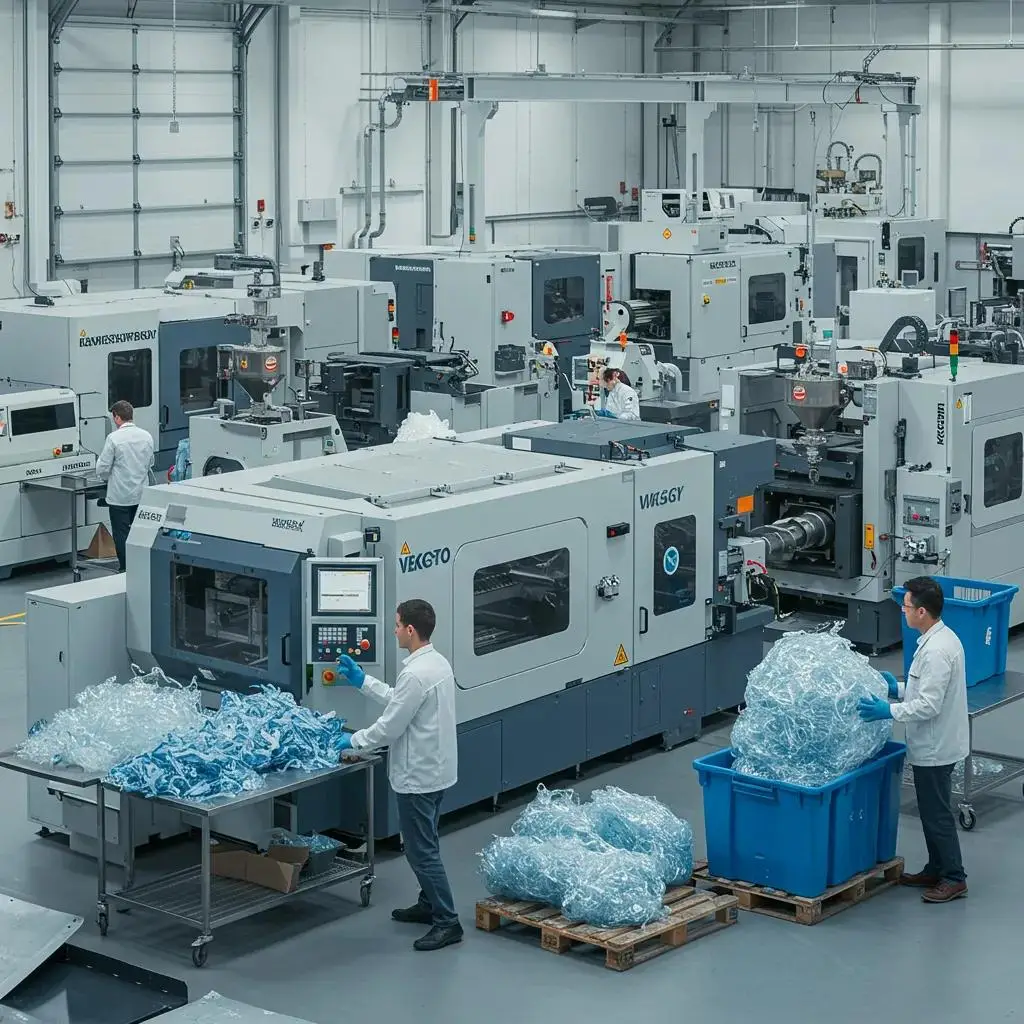
Every second you shave off cycle time goes straight to your bottom line.
Think about it. You’re running a part with a 45-second cycle. Cut that to 40 seconds and you’ve increased throughput by 11%. That’s 11% more parts per shift, 11% better machine utilization, 11% lower cost per part. Over a production run of a million parts, those five seconds add up fast.
But here’s the thing: you can’t just turn up the speed and hope for the best. Reducing cycle time requires understanding what’s actually happening during the cycle and optimizing each phase without sacrificing quality.
Let’s break down where time goes and how to get it back.
Understanding Where Your Time Goes
A typical injection molding cycle has four phases:
- Fill time – plastic is injected into the mold
- Packing/holding time – additional pressure compensates for shrinkage
- Cooling time – part solidifies to the point where it can be ejected
- Mold open, eject, and close time – mechanical movements between shots
For most parts, cooling time is 50-80% of total cycle time. That’s where the biggest opportunities live. But you can’t ignore the other phases—every second counts.
Let me give you real numbers. Say you’ve got a 45-second cycle:
- Fill: 2 seconds
- Pack/hold: 8 seconds
- Cool: 30 seconds
- Mold movement: 5 seconds
Cutting cooling by 20% saves six seconds and drops your cycle to 39 seconds. That’s a 13% improvement. Try getting that from fill time alone and you’ll struggle to save even half a second.
Optimizing Cooling: The Biggest Opportunity
Cooling dominates cycle time, so that’s where we start.
Part thickness is everything. Cooling time increases with the square of wall thickness. Double the wall thickness and cooling time quadruples. That 3mm-thick section in your part? It’s taking way longer to cool than the 1.5mm sections around it.
Work with your design engineer to minimize wall thickness without sacrificing structural requirements. Use ribs for strength instead of thick walls. Every millimeter you reduce in wall thickness cuts cooling time significantly.
Mold temperature matters, but not the way you think. Lower mold temperature means faster cooling, right? Yes. But too low and you get short shots, poor surface finish, or molded-in stress. There’s a sweet spot where the part fills properly and packs well but cools as quickly as possible.
Start by gradually reducing mold temperature by 5-10°F increments while monitoring part quality. Stop when you see defects appear, then back off a bit. Document the optimal temperature for each material and part because it’ll vary.
Cooling channel design is usually set when the mold is built, but you can still optimize what you have. Are cooling channels plugged or scaled? Flush them regularly. Mineral deposits from water restrict flow and reduce heat transfer. An afternoon of maintenance can recover cooling efficiency you didn’t know you’d lost.
Check cooling water temperature and flow rate. In Michigan, your municipal water supply temperature swings 30+ degrees between summer and winter. Use chillers to maintain consistent cooling water temperature year-round—typically 50-70°F depending on your material. And make sure flow rates are adequate. Restricted flow means poor heat transfer.
Balance cooling across the mold. Hot spots create uneven cooling, which means you’re waiting for the slowest section to solidify. Use mold temperature controllers with multiple zones to balance temperatures across complex geometries. Measure mold surface temperature with an infrared thermometer to identify hot spots that need attention.
Advanced cooling techniques can help for high-volume production. Conformal cooling channels that follow part contours provide more uniform cooling than straight-drilled channels. Baffles, bubblers, and thermal pins target specific hot spots. These usually require mold modifications, but the payoff in cycle time reduction can justify the investment.
One more thing: ejection temperature. Parts don’t need to be fully cooled to room temperature—they just need to be rigid enough to eject without distortion. Find the highest ejection temperature where parts still hold their shape. Every degree you can eject warmer saves cooling time.
Packing and Holding: Finding the Minimum
Packing pressure compensates for material shrinkage as the part cools. You need enough to avoid sink marks and short shots, but excess packing just wastes time.
Do a gate seal study. Gradually reduce holding time while monitoring part weight. When part weight drops, the gate is freezing before the end of holding time—you’re wasting time. Set holding time to just after the gate seals plus a small safety margin (1-2 seconds).
For some parts, you can reduce holding pressure without affecting quality. Lower pressure means less residual stress and sometimes faster cooling because there’s less compression of the plastic in the cavity. Test incrementally to find the minimum pressure that maintains part quality.
Optimize switchover from fill to pack. If switchover happens too late, you’re overpacking the cavity unnecessarily. If it’s too early, you get short shots or voids. Use cavity pressure sensors if available, or dial in switchover based on screw position or hydraulic pressure. The goal is to switch right when the cavity is 95-98% full.
Fill Speed: Faster Isn’t Always Better
Fill time is usually a small percentage of total cycle time, but there’s still opportunity here.
Increase injection speed where possible. Faster filling reduces the time plastic spends cooling during injection, which helps thin sections fill before they freeze off. It also reduces cycle time directly—every 0.1 seconds you save on fill adds up.
But there are limits. Too fast and you get jetting (plastic stream that folds over itself), burning from excessive shear heating, or flash from overpressure. Increase speed gradually and watch for defects.
Optimize injection pressure. Use just enough pressure to fill the cavity completely. Excessive pressure wastes energy, loads the machine unnecessarily, and can cause flash. Scientific molding approaches use pressure curves to find the optimal profile.
Material selection affects fill speed. Low-viscosity materials fill faster than high-viscosity ones. If you’re molding a thin-walled part and struggling with fill time, consider a different grade of the same resin with better flow characteristics.
Machine Cycle Time: The Mechanical Stuff
Mold open, part eject, and mold close add time to every cycle. These are mechanical movements you can optimize.
Reduce mold open stroke if possible. Opening the mold just far enough to clear the part saves time compared to opening it all the way. Check that your open stroke setting isn’t excessive.
Increase clamp speed within safe limits. Modern presses can adjust open and close speeds. Faster movements save time, but watch for wear on mechanical components and make sure you’re not slamming the mold shut.
Ejection system optimization can save time. If parts stick during ejection, you’re losing seconds on every cycle. Make sure draft angles are adequate, ejector pins aren’t worn, and parts release cleanly. Add air assists or ejector sleeves if parts stick consistently.
Minimize robot cycle time if you’re using automation. Faster robot movements, optimized paths, and shorter wait times add up. If the robot’s waiting for the press or vice versa, there’s an opportunity to rebalance the cycle.
Material-Specific Strategies
Different plastics have different cooling rates and process characteristics.
Crystalline plastics like polypropylene and nylon cool slower than amorphous plastics like polycarbonate or polystyrene because they release latent heat during crystallization. You can’t change physics, but you can choose materials with faster crystallization rates if cycle time is critical.
Glass-filled materials have better thermal conductivity than unfilled resins, which means faster cooling. If you’re using unfilled plastic and struggling with long cooling times, consider switching to a glass-filled grade. The trade-off is higher injection pressure and more mold wear.
Thin-wall molding materials are specifically formulated for high-flow, fast-cycle applications. If you’re molding thin-walled parts, these specialty grades can significantly reduce cycle time.
Scientific Molding Approach
Scientific molding uses data and process control to optimize every phase of the cycle.
Process monitoring with cavity pressure sensors, mold temperature sensors, and real-time data logging identifies exactly where time is being wasted. You can see when the cavity is full, when the gate seals, and when the part is rigid enough to eject.
Design of experiments (DOE) systematically tests variables like mold temperature, cooling time, injection speed, and packing pressure to find the optimal combination. Instead of guessing, you’re using data to drive decisions.
Process windows define the range where process variables can vary without affecting quality. Understanding your process windows lets you push parameters toward faster cycles while staying within acceptable quality limits.
This stuff sounds complicated, and it is. But for high-volume production, scientific molding pays for itself in cycle time reductions and quality improvements. Work with process engineers who understand these techniques or invest in training for your team.
Real-World Example: Cutting 10 Seconds
Let’s walk through a realistic cycle time reduction.
Starting point: 50-second cycle
- Fill: 2 seconds
- Pack/hold: 10 seconds
- Cool: 33 seconds
- Mold movements: 5 seconds
Step 1: Gate seal study. We find the gate seals after 6 seconds, not 10. Reducing hold time from 10 to 7 seconds saves 3 seconds. New cycle: 47 seconds.
Step 2: Mold temperature reduction. We drop mold temp from 120°F to 110°F. Cooling time drops from 33 to 29 seconds. Save 4 seconds. New cycle: 43 seconds.
Step 3: Ejection temperature optimization. We find parts can eject 10°F warmer without distortion. This saves another 2 seconds of cooling. New cycle: 41 seconds.
Step 4: Cooling channel maintenance. We flush cooling channels and discover scale buildup was restricting flow. Better heat transfer saves 1 more second. New cycle: 40 seconds.
We just cut cycle time by 20%—from 50 to 40 seconds—without changing the mold or the part design. That’s the power of optimization.
Michigan-Specific Considerations
Michigan’s environment affects cycle time in ways you might not expect.
Seasonal water temperature swings change cooling efficiency. In summer, warmer municipal water means longer cooling times. Install chillers to maintain consistent cooling water temperature year-round.
Facility temperature affects material temperature, mold temperature, and cooling uniformity. Parts molded in a 60°F facility in January cool differently than parts molded at 85°F in July. Climate-controlled facilities maintain consistent cycle times year-round.
Material conditioning matters more in Michigan’s humidity swings. Hygroscopic materials that aren’t dried properly take longer to cool and can show defects. Invest in proper drying equipment and maintain it religiously.
Equipment age is a factor in some Michigan facilities. Older hydraulic presses may not hit the same speeds or precision as modern servo-electric machines. Understand your equipment’s limitations and optimize within those constraints. Sometimes upgrading equipment is the only way to achieve target cycle times.
When Cycle Time Reduction Isn’t Worth It
Here’s some honesty: not every cycle time improvement makes business sense.
If you’re running a low-volume job—say, 1,000 parts per year—cutting 5 seconds off cycle time saves about 80 minutes annually. That’s not worth days of process development, mold modifications, or equipment upgrades.
High-volume production is where cycle time reduction pays off. If you’re running 10 million parts per year, saving 5 seconds per cycle saves 13,889 hours of machine time. That’s massive.
Also, quality always comes first. If reducing cycle time means accepting higher reject rates or compromising dimensional stability, it’s not worth it. A part that’s 5 seconds faster but fails in the field is a disaster, not an improvement.
Calculate the ROI before chasing cycle time. How many parts per year? What’s machine time worth? What will optimization efforts cost? Make data-driven decisions, not emotional ones.
Implementation: Start Simple
Don’t try to optimize everything at once. That’s how you lose track of what’s working.
Start with low-hanging fruit: gate seal studies, mold temperature adjustments, cooling water optimization. These require minimal investment and often yield significant improvements.
Then move to intermediate optimizations: ejection temperature, fill speed adjustments, machine cycle time. These need more testing but still don’t require capital investment.
Finally, consider advanced techniques like mold modifications, conformal cooling, or scientific molding if volumes justify it.
Document everything. Record baseline cycle times, changes made, and results. Build a knowledge base so you’re not relearning the same lessons six months later.
And involve your operators. They run the machines every day and notice things engineers miss. A good operator can tell you exactly where time is being wasted and what’s working or not working on the production floor.
Boost Injection Molding Throughput with Small Cycle Time Reductions
Cycle time reduction is about understanding your process, identifying opportunities, and optimizing systematically.
Cooling time is your biggest target—attack it first through part design, mold temperature, cooling system optimization, and ejection temperature.
Don’t ignore packing, fill time, and machine movements. Small improvements across multiple phases add up.
Use data to drive decisions. Guessing wastes time and money. Measuring, testing, and documenting gets results.
And remember: Michigan’s environment affects your process. Account for seasonal changes, invest in proper equipment, and maintain systems that keep conditions consistent.
Because every second you save multiplies across thousands or millions of cycles. And that adds up to parts produced faster, machine utilization maximized, and margins improved.
Which means you’re not just making parts. You’re making them efficiently enough to win business, stay competitive, and keep production running profitably for the long haul.
Discuss your project
Talk with the Ronningen team
Share your part design, material requirements, expected quantities and delivery needs. Our team can review the next steps with you.