Here’s a conversation that happens way too often:
Engineer designs a part in California. Specs a plastic that works great in their 72-degree lab. Ships it to Michigan for production. Six months later, parts are failing in the field because nobody considered what happens when that plastic sees actual Michigan weather.
You know—temperatures swinging from -10°F in January to 95°F in July. Humidity jumping from 30% to 85%. Ice, road salt, UV exposure, thermal cycling that would make a thermostat cry.
Let’s talk about choosing plastics that actually survive Michigan’s climate, not just the theoretical one in a textbook.
Why Michigan’s Climate Breaks Things
Michigan doesn’t have weather. It has weather events.
Winter brings subzero temperatures that make some plastics brittle as glass. You’ve probably seen it—a polypropylene bumper or a polycarbonate housing that shatters on impact at -5°F when it would’ve flexed fine at room temperature.
Summer heat isn’t much friendlier. Automotive interiors hit 150°F or higher when parked in the sun. Dashboard components warp, soften, or outgas chemicals that fog up your windshield. Outdoor equipment sitting on blacktop sees similar temperatures.
And then there’s the humidity. Summer mornings with 90% humidity followed by dry winter air at 20%. Hygroscopic plastics absorb and release moisture with every swing, which causes dimensional changes, strength loss, and sometimes stress cracking.
UV exposure year-round degrades polymers, especially in summer when the sun’s hitting your outdoor equipment for 15 hours a day. Colors fade, surfaces chalk, mechanical properties deteriorate.
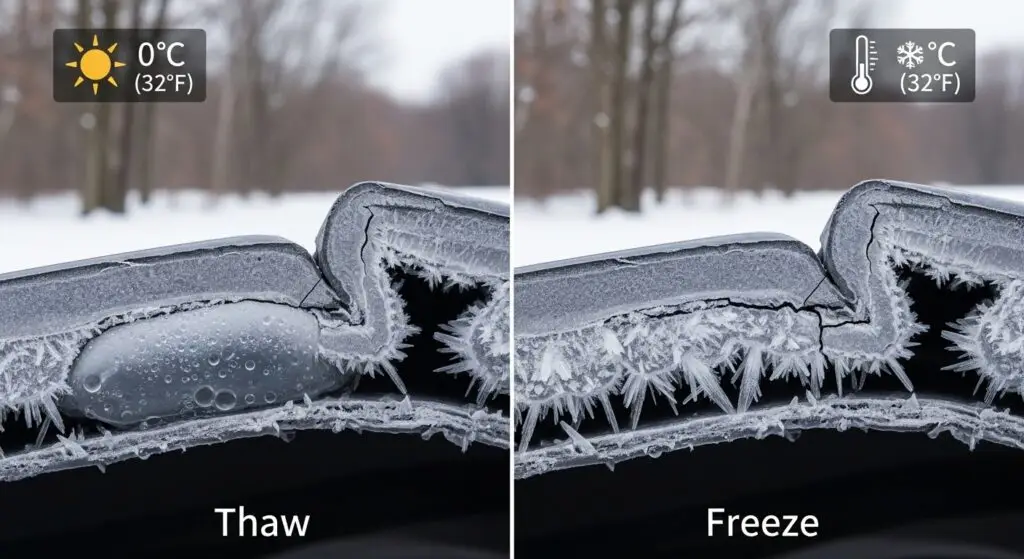
But here’s the real killer: thermal cycling. It’s not just the temperature extremes. It’s the constant expansion and contraction as parts heat and cool. That cycling fatigues materials and causes creep, cracking, and failure at stress points.
Oh, and road salt. If your parts are anywhere near Michigan roads from November through April, they’re getting coated with salt, calcium chloride, and whatever else MDOT’s using that year. Some plastics handle it fine. Others corrode, craze, or fail catastrophically.
The Plastics That Handle Cold
Let’s start with winter because that’s where most failures happen.
Polypropylene (PP) is everyone’s first choice because it’s cheap and processable. But standard PP gets brittle below freezing. If you’re using PP for anything that sees impact in winter—automotive parts, outdoor equipment, tool housings—you need impact-modified grades.
Look for PP copolymers or blends with EPR (ethylene-propylene rubber). These maintain toughness down to -20°F or lower. Yeah, they cost more. But warranty claims cost way more.
High-Density Polyethylene (HDPE) handles cold better than PP. It stays tough and impact-resistant even at subzero temperatures. That’s why snowmobile parts, outdoor toys, and storage containers use HDPE. The trade-off is lower stiffness and a higher coefficient of thermal expansion—parts move more with temperature changes.
Polycarbonate (PC) maintains impact strength across a wide temperature range, including subzero. It’s tough, dimensionally stable, and handles cold better than most thermoplastics. The downside is moisture absorption and cost. You need to dry it thoroughly before molding and it’s not cheap.
ABS is temperature-sensitive. Standard ABS gets noticeably brittle below 20°F. If you need ABS for winter applications, consider ABS/PC blends that combine ABS processability with PC toughness.
Nylon (PA) handles cold reasonably well, especially glass-filled grades. But moisture is your enemy. Nylon absorbs water, which plasticizes it and changes dimensions. In winter, parts shrink as humidity drops. In summer, they swell. For critical dimensions, nylon can be problematic in Michigan unless you control moisture carefully.
Acetal (POM) is underrated for cold-weather applications. It maintains stiffness and toughness at low temperatures, has excellent dimensional stability, and very low moisture absorption. It’s great for gears, bearings, and structural components that need to work in unheated spaces.
Plastics That Handle Heat
Summer heat is a different challenge. You need materials that maintain properties at elevated temperatures without warping or losing strength.
Glass-Filled Nylon shines in high-heat applications. It maintains stiffness and strength up to 200°F or more, making it ideal for under-hood automotive parts, outdoor power equipment, and anything exposed to direct sunlight. The glass reinforcement reduces thermal expansion and increases heat deflection temperature.
Polycarbonate works well in heat too, with continuous use temperatures around 240°F. It’s why you see PC in automotive lighting, outdoor enclosures, and electrical components.
PET and PBT (polyester plastics) handle heat well with good dimensional stability and low moisture absorption. They’re tougher to process than nylon or PC but worth it for applications needing heat resistance without the cost of engineering resins.
Polyphenylene Sulfide (PPS) and other high-temp engineering resins are overkill for most applications, but if you need continuous operation above 300°F, they’re the answer. Expensive as hell but bulletproof in terms of heat resistance.
Avoid standard polystyrene, unmodified PP, and low-grade polyethylene in high-heat applications. They soften, warp, or lose mechanical properties above 150°F.
UV Resistance: The Silent Killer
UV degradation sneaks up on you. Parts look fine for six months, then suddenly they’re chalky, discolored, and brittle.
Any plastic used outdoors in Michigan needs UV stabilization. Period.
UV stabilizers are additives that absorb or block UV radiation before it breaks down polymer chains. Carbon black is the cheapest and most effective UV stabilizer—that’s why black plastic lasts forever outdoors. If you need other colors, use UV-stabilized grades with specific additives designed for outdoor use.
ASA (Acrylonitrile Styrene Acrylate) is ABS’s outdoor-friendly cousin. It has built-in UV resistance and maintains color and properties for years of outdoor exposure. More expensive than ABS but worth it for parts that see sunlight.
Polycarbonate with UV coating works for outdoor applications, but uncoated PC degrades relatively quickly in UV. If you’re using PC outdoors, specify UV-stabilized grades or plan on a protective coating.
Acrylic (PMMA) has excellent UV resistance and maintains clarity for years. That’s why outdoor lighting, signage, and glazing use acrylic. It’s not as impact-resistant as PC but it won’t yellow or cloud from UV exposure.
Don’t assume “outdoor-grade” means UV-stable. Check the actual UV stabilizer package in the material datasheet. Hours of QUV testing, weatherometer data, or outdoor Florida exposure test results tell you what you need to know.
Moisture: The Dimension-Changer
Michigan humidity swings are brutal for hygroscopic plastics.
Hygroscopic materials like nylon, polycarbonate, and ABS absorb moisture from air. As they absorb water, they swell, lose strength, and change dimensions. In humid summer conditions, parts can grow enough to cause fit issues. In dry winter air, they shrink.
For critical applications, consider non-hygroscopic alternatives:
Acetal absorbs virtually no moisture and maintains tight tolerances regardless of humidity. It’s ideal for precision parts, gears, and assemblies with tight fits.
Polypropylene and polyethylene don’t absorb moisture. Dimensions stay stable across humidity changes.
Glass-filled polyester (PBT) has very low moisture absorption compared to nylon while offering similar mechanical properties.
If you must use hygroscopic materials, design with moisture-driven dimensional changes in mind. Add clearances where parts fit together. Use moisture barrier packaging for storage and shipping. And communicate with your customer about environmental conditioning before assembly.
Chemical Resistance: Road Salt and More
Michigan roads get treated with rock salt, calcium chloride, magnesium chloride, and various brines depending on the county and temperature. If your parts go on vehicles or outdoor equipment, they’re swimming in this stuff all winter.
Polypropylene and polyethylene resist road salt and most chemicals. That’s why they dominate automotive underbody components, mud flaps, and wheel liners.
Nylon handles salt fine but remember the moisture absorption issue—salt solutions accelerate water absorption.
Polycarbonate can stress crack when exposed to certain chemicals. If you’re using PC in automotive or outdoor applications, test it with the actual chemicals it’ll encounter.
ABS has decent chemical resistance but not as good as PP or PE. It can craze or crack with prolonged exposure to aggressive chemicals.
For agricultural applications, consider exposure to fertilizers, herbicides, and diesel fuel. For industrial equipment, think about lubricants, hydraulic fluids, and cleaning solvents. Match your material to the chemical environment, not just the mechanical requirements.
Thermal Expansion: The Movement Nobody Sees
Plastics expand and contract with temperature way more than metals. If you’re used to designing with aluminum or steel, you’re in for a surprise.
Coefficient of thermal expansion (CTE) matters in Michigan’s 100°F+ annual temperature swing. A 12-inch unfilled polypropylene part grows and shrinks almost 1/8″ over that temperature range. That’s enough to cause binding, misalignment, or gaps in assemblies.
Glass-filled materials have much lower CTEs. Adding 30% glass to nylon or PP reduces thermal expansion by half or more. If dimensional stability across temperature is critical, use reinforced grades.
Design for movement. If you’re fastening plastic parts to metal structures or combining materials with different CTEs, allow for movement. Use slotted holes, flexible attachment points, or elastomeric interfaces that accommodate expansion and contraction.
And remember: parts mold at one size in a controlled environment, then get assembled and used in real-world conditions. That 70-degree part you measured in your QC lab will be a different size at -10°F or 150°F in the field.
Matching Materials to Applications
Let’s get practical. Here’s what actually works for common Michigan applications:
Automotive exteriors: ASA or impact-modified PP with UV stabilization. Black whenever possible for maximum UV resistance.
Automotive interiors: PC/ABS blends for dashboards and trim. They handle heat, maintain surface quality, and process cleanly. Use low-VOC grades to avoid fogging.
Under-hood automotive: Glass-filled nylon 6/6 for heat resistance and strength. PA66 with heat stabilizers handles continuous heat better than PA6.
Outdoor power equipment: Glass-filled PP or HDPE for housings and structural parts. They handle impacts, UV, and chemical exposure.
Outdoor electrical enclosures: ASA, polycarbonate with UV stabilizers, or glass-filled PBT. These maintain properties and appearance for years of outdoor exposure.
Agricultural equipment: HDPE or PP for corrosion resistance and impact strength. Nylon for structural components needing strength.
Outdoor furniture and consumer products: HDPE or UV-stabilized PP. Acetal for moving parts and hinges.
Precision components: Acetal for dimensional stability and low moisture absorption. Glass-filled nylon for strength with tighter tolerances than unfilled grades.
Testing for Michigan Conditions
Don’t assume materials work in Michigan just because they work somewhere else. Test in actual conditions or simulate them.
Thermal cycling from -20°F to 150°F reveals dimensional issues, stress cracking, and fatigue failures you won’t see in static tests.
UV exposure chambers accelerate aging. A few hundred hours of QUV testing tells you if your material and color will survive years of Michigan sun.
Chemical resistance testing with road salt, cleaning chemicals, and fluids your parts will actually encounter prevents surprises after production.
Impact testing at temperature shows whether your material stays tough at -10°F or gets brittle.
Work with your material supplier to get samples of UV-stabilized grades, impact-modified versions, or alternative resins. Mold test parts and expose them to real Michigan weather for a few months. You’ll learn more from actual exposure than from a dozen datasheets.
The Cost-Performance Balance
Engineering resins that handle Michigan’s climate cost more than commodity plastics. But failure costs more than material upgrades.
Calculate the true cost. A part that fails after six months means warranty claims, replacement parts, shipping, installation labor, and reputation damage. Spending an extra $0.50 per pound on UV-stabilized resin is cheap compared to replacing a thousand failed parts in the field.
Sometimes you can reduce cost by using the expensive material only where needed. Overmold a glass-filled nylon structure with softer PP for grip areas. Use UV-resistant material on exterior surfaces while using cheaper stuff for internal components.
And don’t over-engineer. If your part lives inside a building its whole life, you don’t need outdoor UV resistance. Match the material to the actual environment, not the worst-case scenario you can imagine.
Working With Suppliers
Your material supplier knows more about resin performance than any datasheet tells you. Use them.
Explain your application honestly. Where does the part live? What temperatures does it see? What chemicals is it exposed to? What kind of impacts or stresses? The more details you give, the better their material recommendation.
Ask for similar applications. “What material do you recommend for outdoor electrical enclosures in the Midwest?” They’ve probably solved that problem a hundred times.
Get samples of multiple grades and test them. Most suppliers will send small quantities of candidate materials for evaluation molding.
And document everything. When you find a material that works, record the exact grade, supplier, and processing parameters. Material formulations change over time, and you want to catch any changes before they cause field failures.
Key Takeaways for Michigan Plastic Material Selection
Michigan’s climate is harsh, but it’s not impossible. Choose materials that match your application’s real-world environment, not just its mechanical requirements.
Consider temperature extremes, humidity swings, UV exposure, and chemical exposure. Test in actual conditions when possible. Work with suppliers who understand Midwest applications.
And remember: the cheapest material is rarely the right material for Michigan. The right material is the one that keeps working for years without failures, warranty claims, or angry customers.
Because a part that survives Michigan winters and summers is a part that’ll work anywhere.